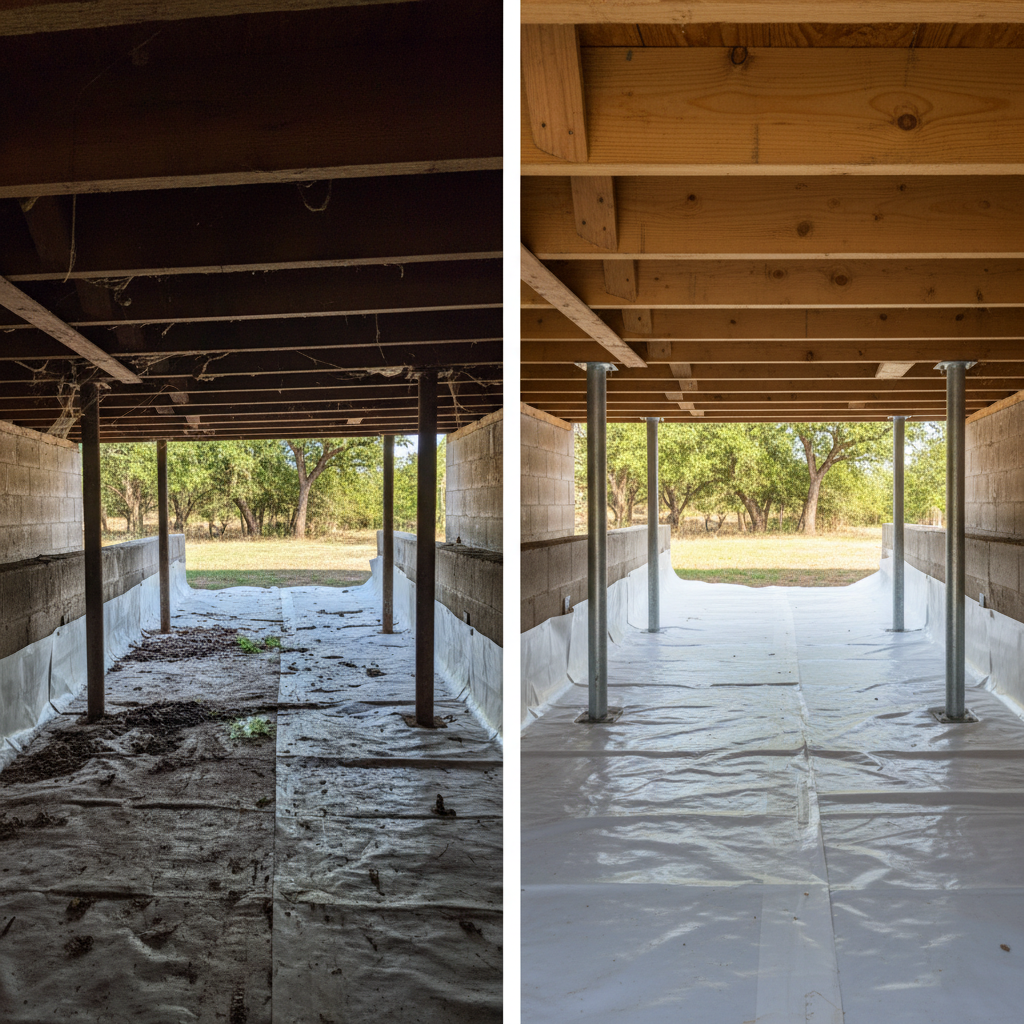
Ever crawl under your house and catch that damp scent hanging in the air? Down here in Elmendorf, our local clay-heavy soil holds onto moisture long after a heavy rain rolls through. When water starts pooling beneath your floorboards, homeowners have to make a choice on how to fix it before it wrecks the framing. Homeowners usually end up looking at two primary approaches for Water Damage Restoration and crawl space water removal: traditional passive gravity drainage systems versus active mechanical sump pump setups.
The Passive Gravity Drainage Approach
Passive drainage relies entirely on natural slopes and gravity to move water away from your foundation. This usually involves installing French drains around the exterior or interior perimeter of the crawl space, routing water out to a lower point in the yard without using any electricity.
When it comes to upfront costs, passive systems are generally easier on the wallet initially because you are not paying for pumps, battery backups, or ongoing electrical use. Maintenance is also straightforward. Once those lines and gravel beds are correctly installed, there are not many moving parts to break down. The catch? Gravity only works if your property has the right slope. In flat areas or sections with stubborn clay pockets, getting enough fall to move water out completely can be a real headache.
The Active Sump Pump System
Active removal means collecting the water in a designated basin dug into the lowest point of your crawl space and using an electric pump to force it up and away from the house. Pinnacle Restoration Inc often sees homes that simply cannot drain passively because of how the lot grading sits.
Upfront costs for an active system run higher. You are buying the pump, liner, check valves, and usually a secondary battery backup for when the local power blinks out during a severe South Texas storm. You also have to factor in maintenance. Pumps have mechanical parts, switches can fail, and intakes can get clogged with silt over time. You cannot just install it and forget about it for ten years.
Durability and Performance in Local Conditions
Durability comes down to matching the system to our regional environment. Passive drains last for decades if they are wrapped properly to keep clay silt from clogging the fabric. However, during torrential downpours when the ground is entirely saturated, passive drains can get overwhelmed.
Active sump pumps handle high-volume water intrusion much faster. If you get a sudden deluge, a heavy-duty pump will kick on and clear hundreds of gallons an hour. But you do have to deal with the appearance and footprint of the basin and discharge lines, plus the hum of a motor when it activates.
Making the Right Choice
If your lot has good natural slope and minor seepage, a well-built passive drainage system might be all you need. For properties in Elmendorf dealing with standing water and heavy clay subsurfaces, Pinnacle Restoration Inc provides Water Damage Restoration services to keep your structure dry.